AMPTEK Si-PIN X-Ray Detectors
The Si-PIN X-ray Detector is a high-performance, thermoelectrically cooled detector designed to deliver reliable and accurate X-ray spectroscopy measurements. Ideally suited for laboratory and analytical applications, the Si-PIN detector provides an excellent balance of energy resolution, count-rate performance, and cost-effectiveness. It is particularly well suited for applications requiring moderate energy resolution and count rates, offering a dependable and economical solution for X-ray spectroscopy and elemental analysis.

Price on request
Tell us about your application and we'll send a tailored quote, including lead time and an expert recommendation.
Amptek Si-PIN X-Ray Detectors – High Performance, Precision, and Cost-Effective Solutions
Amptek's Si-PIN X-ray detectors combine advanced silicon detector technology, thermoelectric cooling, and precision electronics to deliver reliable, high-performance X-ray spectroscopy in a compact and cost-effective design.
By bringing silicon wafer manufacturing in-house and optimizing its production processes, Amptek has significantly improved detector performance, achieving lower electronic noise, reduced leakage current, enhanced charge collection efficiency, and excellent detector-to-detector uniformity. These advancements position Amptek's Si-PIN technology among the leading solutions for precision X-ray detection.
Reliable Performance for X-Ray Spectroscopy and XRF Applications
The Si-PIN is a high-performance, thermoelectrically cooled X-ray detector that can be integrated with various preamplifier and digital pulse processing configurations.
Designed primarily for laboratory X-ray spectroscopy applications, it offers an excellent balance of energy resolution, count-rate capability, reliability, and affordability, making it ideal for applications requiring moderate resolution and count rates without compromising measurement quality.
Typical applications include:
X-ray Fluorescence (XRF) Analysis – Accurate identification and characterization of elemental compositions.
Metal Alloy Identification – Determination and verification of metal alloy compositions.
RoHS/WEEE Compliance Testing – Screening materials for restricted substances and supporting regulatory compliance.
Lead Detection in Paint – Identification and measurement of lead content in coatings and painted surfaces.
Advanced Detector Technology and Performance
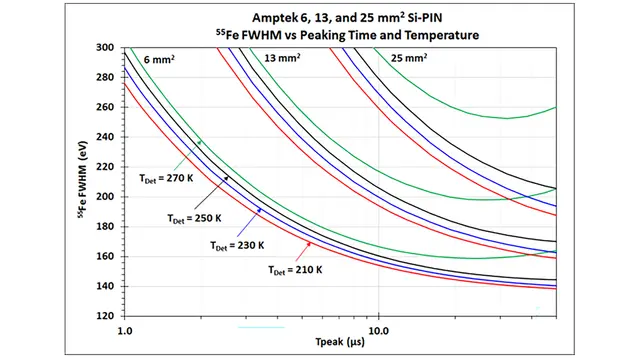
Amptek Si-PIN detectors deliver energy resolution ranging from 139 to 225 eV FWHM, depending on the detector's active area and configuration.
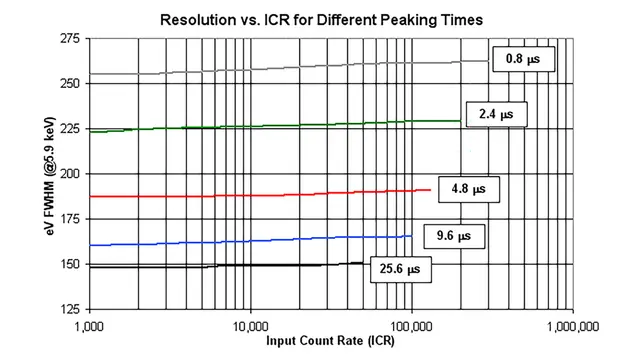
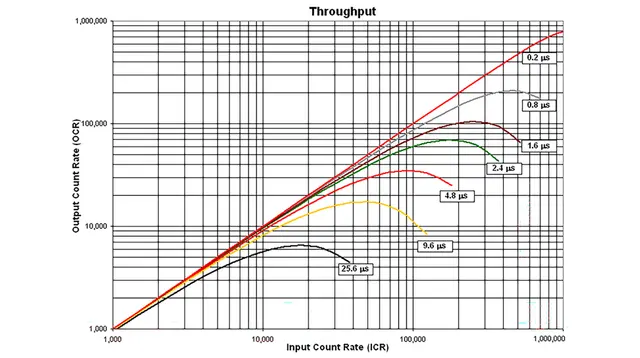
Optimized for count rates below 30,000 counts per second (30 kcps), these detectors provide dependable performance across an X-ray energy range of 1.5 to 30 keV.
The detector incorporates a fully depleted, 500 µm-thick Si-PIN photodiode, ensuring efficient charge collection and consistent spectral performance.
Available entrance window options include:
Beryllium (Be): 1 mil thickness.
Boron Carbide (B₄C): An alternative window option for specific measurement requirements.
XR-100CR – Flexible Detector Configuration for Laboratory Applications
The XR-100CR configuration features a Si-PIN detector mounted on an extender, available in multiple lengths, with the charge-sensitive preamplifier housed in an attached metal enclosure.
To operate as a complete spectroscopy system, the XR-100CR requires an external signal processor and appropriate power supplies.
Amptek's PX5 Digital Pulse Processor is the recommended solution, providing advanced signal processing capabilities and flexibility for laboratory research and analytical applications.
The same Si-PIN detector technology is also available in the compact X-123 configuration or with smaller preamplifier options for OEM integration and customized instrumentation.
X-123 – Complete X-Ray Spectroscopy System in a Compact Package
The Amptek X-123 integrates a complete X-ray detection and signal processing system into a compact, handheld-size enclosure.
Developed through years of continuous innovation in X-ray detector technology, the X-123 reflects Amptek's commitment to creating compact, low-power, high-performance instruments that are simple to integrate and operate.
The system combines three essential components within a single enclosure:
XR-100CR X-Ray Detector and Charge-Sensitive Preamplifier – Provides accurate X-ray detection and low-noise signal amplification.
DP5 Digital Pulse Processor – Incorporates pulse shaping, a multichannel analyzer (MCA), and communication interfaces for advanced spectral processing.
PC5 Power Supply – Provides the required operating power for the detector and associated electronics.
The X-123 requires only a +5 V DC power input and a USB or RS-232 connection to a computer, enabling straightforward setup and operation.
Versatile Solutions for Laboratory and OEM Integration
Whether used in laboratory spectroscopy, XRF analysis, industrial inspection, or custom OEM instrumentation, Amptek Si-PIN detectors offer a combination of measurement accuracy, compact design, low power consumption, and cost-effective performance.
With flexible configurations ranging from the modular XR-100CR to the fully integrated X-123, Amptek provides reliable X-ray detection solutions tailored to a wide range of analytical and industrial applications.
Amptek XR-100CR – High-Performance Si-PIN X-Ray Detector
Advanced X-Ray Detection Technology for Reliable and Cost-Effective Spectroscopy
The Amptek XR-100CR represents a major advancement in X-ray detection technology, delivering high-quality spectroscopy performance that was previously achievable only with expensive cryogenically cooled detector systems.
Although newer technologies such as Amptek's XR-100SDD and FastSDD® offer enhanced capabilities, the XR-100CR remains a widely used solution in the X-ray fluorescence (XRF) industry, thanks to its excellent balance of performance, reliability, compact design, and affordability.
Thermoelectrically Cooled Si-PIN Detector Technology
At the heart of the XR-100CR is a high-performance Si-PIN photodiode, designed for precise X-ray detection and energy measurement.
A two-stage thermoelectric cooler maintains the detector and its input JFET transistor at approximately -55°C, significantly reducing electronic noise without requiring liquid nitrogen or other cryogenic cooling systems.
This advanced cooling technology enables excellent energy resolution and stable operation in a compact, convenient, and energy-efficient package.
Advanced Detector Construction and Low-Noise Design
The XR-100CR detector is housed in a hermetically sealed TO-8 package, featuring a thin beryllium (Be) entrance window that is both light-tight and vacuum-tight, allowing efficient detection of low-energy X-rays.
The internal vacuum environment enhances thermal efficiency, while an integrated multilayer collimator minimizes background interference and unwanted spectral artifacts.
To further improve measurement accuracy, the detector incorporates an innovative reset-type charge-sensitive preamplifier, using a unique high-voltage reset technique that reduces electronic noise and enhances energy resolution.
Flexible Configurations for Laboratory and OEM Applications
The XR-100CR features a charge-sensitive preamplifier enclosed in a compact metal housing measuring 3.0 × 1.75 × 1.125 inches, with the detector mounted on an optional extender.
Available configurations include:
No extender
1.5-inch extender
5-inch extender
9-inch extender
The 5-inch and 9-inch extender configurations are particularly suitable for vacuum-based X-ray measurements when used with the optional CP75 vacuum flange.
Alternative compact preamplifier configurations are also available for OEM integration and applications where installation space is limited.
Efficient X-Ray Detection and Charge Collection
When X-rays interact with silicon atoms, they generate electron-hole pairs, with approximately 3.62 eV of deposited energy required to produce each pair.
Depending on the incident X-ray energy, these interactions occur primarily through the photoelectric effect or Compton scattering.
The detector's X-ray absorption efficiency increases with silicon thickness, enabling improved detection performance across different energy ranges.
To ensure efficient charge collection, a bias voltage of approximately 100–200 V, depending on detector thickness, is applied across the silicon.
Thermoelectric cooling significantly reduces leakage current, allowing the detector to operate at these higher bias voltages without the excessive leakage or electrical breakdown associated with room-temperature operation.
The increased bias voltage also reduces detector capacitance, contributing to lower electronic noise and improved spectral performance.
Optimized Cooling for Superior Energy Resolution
The thermoelectric cooling system simultaneously cools the silicon detector and the input field-effect transistor (FET) of the charge-sensitive preamplifier.
Cooling the FET reduces leakage current and increases transconductance, resulting in lower electronic noise, improved signal quality, and enhanced energy resolution.
This integrated cooling approach is essential to achieving reliable, high-performance X-ray spectroscopy without bulky cryogenic equipment.
Innovative High-Voltage Reset Technology
Unlike conventional charge-sensitive preamplifiers that rely on a dedicated reset transistor, the XR-100CR incorporates an advanced feedback reset mechanism.
Instead of using a traditional reset transistor, the system performs the reset through the detector's high-voltage connection by injecting a precisely controlled charge pulse through the detector capacitance to the input FET.
This innovative approach eliminates the noise contribution associated with conventional reset transistors, further improving energy resolution and overall detector sensitivity.
Temperature Monitoring and Control
The XR-100CR includes an integrated temperature-monitoring diode mounted directly on the cooled substrate, providing accurate measurement of the detector's internal operating temperature.
When operating below -20°C, small temperature variations of a few degrees have minimal impact on detector performance. As a result, closed-loop temperature control is generally unnecessary under normal laboratory ambient conditions.
For OEM applications, portable instruments, and handheld XRF analyzers, however, active closed-loop temperature regulation is recommended to maintain consistent performance under varying environmental conditions.
Amptek's Active Temperature Control technology is integrated as a standard feature in compatible electronics, including the PX5 and DP5/PC5 systems.
Reliable Performance Across Diverse X-Ray Applications
Combining thermoelectric cooling, low-noise electronics, efficient charge collection, and flexible mechanical configurations, the Amptek XR-100CR delivers dependable X-ray detection for a wide range of analytical applications.
Its proven design, compact size, and cost-effective operation make it an excellent choice for XRF spectroscopy, elemental analysis, laboratory research, industrial testing, vacuum measurements, and OEM instrumentation.
X-Ray Detection Efficiency and Photon Interaction Probability
Figure 6 (Logarithmic Scale) illustrates the probability of an incident X-ray photon interacting with the silicon detector, including the probability of a photoelectric interaction that results in complete energy deposition.
At lower X-ray energies, the photoelectric effect is the dominant interaction mechanism, enabling the detector to absorb the photon's full energy. At higher energies, particularly above approximately 40 keV, Compton scattering becomes increasingly significant, causing photons to deposit only a portion of their energy within the detector.
Influence of the Beryllium Window and Silicon Detector Thickness
Both figures account for the combined effects of X-ray transmission through the beryllium (Be) entrance window, including its protective coating, and photon interactions within the silicon detector.
The detector's overall efficiency depends primarily on two factors:
Low-Energy X-Rays: Detection efficiency is mainly determined by the thickness of the beryllium entrance window. Thinner windows improve the transmission of low-energy photons.
High-Energy X-Rays: Detection efficiency is primarily influenced by the active thickness of the silicon detector. A thicker active silicon layer increases the probability of absorbing higher-energy photons.
Depending on the selected entrance window, approximately 90% of incident X-ray photons reach the detector at energies between 2 and 3 keV.
Similarly, depending on the detector configuration, approximately 90% of photons are detected at energies up to 9–12 keV.
These characteristics demonstrate the importance of selecting the appropriate window material and detector thickness to optimize performance for specific X-ray spectroscopy applications.
Detector Efficiency Data Package
The Efficiency Package is available as a downloadable ZIP archive containing detector efficiency coefficients and a Frequently Asked Questions (FAQ) document.
This information is provided for general reference and technical evaluation purposes only. It should not be used as the basis for critical quantitative analysis or applications requiring independently validated efficiency calculations.
Theoretical Energy Resolution as a Function of X-Ray Energy
| Electronic Noise | Energy | Total Resolution (eV FWHM) | |||||
| 81 | 90 | 127 | 160 | 190 | 219 | ||
| Al Kα | 1.49 | 101 | 108 | 141 | 171 | 200 | 227 |
| Si Kα | 2.31 | 111 | 117 | 148 | 177 | 205 | 232 |
| Ag Lα | 2.98 | 118 | 124 | 153 | 181 | 209 | 235 |
| Cr Kα | 5.41 | 141 | 146 | 172 | 197 | 222 | 248 |
| 55Fe | 5.89 | 145 | 150 | 175 | 200 | 225 | 250 |
| Cu Kα | 8.05 | 162 | 167 | 189 | 213 | 236 | 260 |
| Au Lα | 9.71 | 174 | 178 | 200 | 222 | 245 | 268 |
| Hg Lα | 9.99 | 176 | 180 | 202 | 224 | 246 | 269 |
| Pb Lα | 10.55 | 180 | 184 | 205 | 227 | 249 | 272 |
| U Lα | 13.61 | 200 | 203 | 222 | 243 | 264 | 285 |
| Mo Kα | 17.48 | 222 | 225 | 243 | 261 | 281 | 301 |
| Ag Kα | 22.16 | 246 | 249 | 265 | 282 | 301 | 320 |
| Sn Kα | 25.27 | 261 | 264 | 279 | 295 | 313 | 331 |
| 241Am | 59.54 | 300 | 302 | 402 | 413 | 426 | 440 |
| Pb Kα | 74.96 | 435 | 437 | 446 | 457 | 468 | 481 |
| U Kα | 98.43 | 497 | 498 | 506 | 516 | 526 | 537 |
Example: Find the 55Fe row in the above table and locate the resolution of the detector (bold). The column with that resolution lists the resolutions of that detector for these common energies.
XR-100CR Si-PIN – X-Ray Spectroscopy Applications and Spectral Analysis
The Amptek XR-100CR Si-PIN X-Ray Detector is widely used in X-Ray Fluorescence (XRF) spectroscopy, a powerful analytical technique for identifying and measuring the elemental composition of materials.
XRF analysis provides rapid, accurate, and non-destructive elemental characterization, making it an ideal solution for laboratory research, industrial quality control, material verification, and regulatory compliance testing.
RoHS/WEEE Compliance Testing
The RoHS (Restriction of Hazardous Substances) and WEEE (Waste Electrical and Electronic Equipment)directives establish requirements for restricting hazardous substances in electrical and electronic equipment and managing electronic waste.
XRF spectroscopy is an effective screening method for identifying and measuring regulated elements associated with substances such as:
Lead (Pb)
Cadmium (Cd)
Mercury (Hg)
Hexavalent Chromium (Cr VI) – XRF measures total chromium, not its oxidation state.
Bromine (Br) – Used as an indicator for certain restricted brominated flame retardants, including PBB and PBDE.
The XR-100CR Si-PIN detector enables rapid, accurate, and non-destructive elemental screening, helping manufacturers and suppliers assess material compliance and support quality assurance programs.
By integrating XRF analysis into their inspection processes, companies can verify incoming materials, evaluate supplier compliance, and identify potentially restricted substances before products enter production.
The accompanying X-ray spectrum illustrates the characteristic fluorescence peaks produced by a sample containing chromium (Cr), lead (Pb), and cadmium (Cd), demonstrating the detector's ability to identify multiple elements within a single measurement.
Note: XRF provides elemental screening and may require complementary analytical methods to confirm specific chemical compounds, oxidation states, or full regulatory compliance.
XRF Analysis of Stainless Steel 316 (SS316)
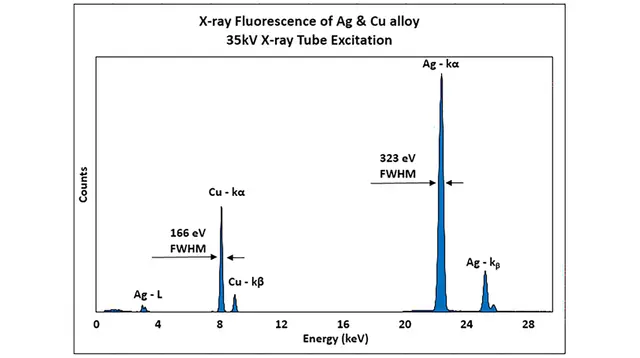
X-Ray Fluorescence spectroscopy is widely used for metal alloy identification and verification by analyzing the characteristic X-ray emissions of individual elements.
Each metal alloy contains a specific combination and proportion of elements. By evaluating the energies and relative intensities of fluorescence peaks, XRF can identify the elemental composition of a sample and help determine its alloy grade without damaging the material.
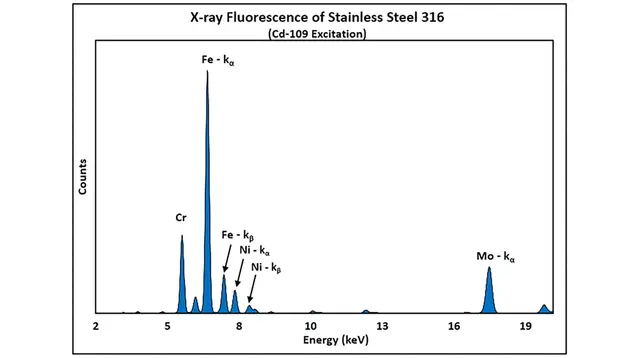
The accompanying spectrum illustrates the X-ray fluorescence response of a 316 stainless steel (SS316) sample excited using a ¹⁰⁹Cd radioactive source.
The prominent iron (Fe) peak confirms the iron-based composition of the material, while the characteristic peaks of chromium (Cr), manganese (Mn), nickel (Ni), and molybdenum (Mo) provide the information needed to identify and distinguish the alloy.
This capability is particularly valuable in applications such as:
Quality Assurance and Material Verification – Confirming that supplied components are manufactured from the specified metal alloys.
Positive Material Identification (PMI) – Verifying alloy grades and material composition in industrial environments.
Manufacturing Process Control – Monitoring material consistency and preventing incorrect alloy selection.
Metal Recycling and Sorting – Identifying and separating metals according to their elemental composition.
Incoming Material Inspection – Checking raw materials and components before manufacturing or assembly.
With its combination of reliable energy resolution, low operating costs, and non-destructive measurement capabilities, the Amptek XR-100CR provides a practical and efficient solution for XRF-based material identification and elemental analysis.
XRF Analysis of Lead (Pb) – Non-Destructive Lead Detection
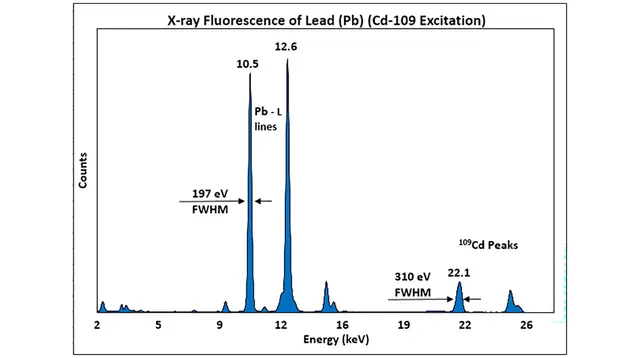
Lead (Pb) detection is an important application of X-Ray Fluorescence (XRF) spectroscopy, particularly in material identification, environmental screening, industrial quality control, and product safety testing.
Lead has historically been used in a wide range of products and materials, including paints, plumbing solders, electronic assemblies, and industrial components. Due to its toxicity and associated regulatory restrictions, reliable methods for detecting lead are essential.
XRF spectroscopy provides a rapid, accurate, and non-destructive method for identifying the presence of leadwithout damaging or altering the material being tested. This makes it particularly valuable for inspecting finished products, electronic components, coatings, and other materials where preserving the original sample is important.
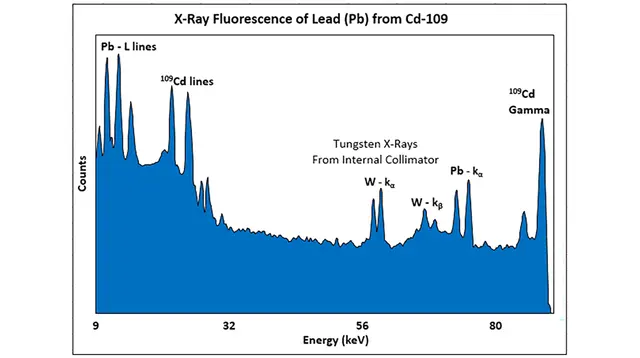
The accompanying X-ray spectrum illustrates the characteristic L-series X-ray emission peaks of pure lead (Pb), generated using a Cadmium-109 (¹⁰⁹Cd) excitation source.
These distinctive fluorescence peaks enable reliable identification of lead, demonstrating the effectiveness of XRF technology for elemental analysis, material verification, and lead screening applications.
XRF Analysis of Plating on Steel Connectors
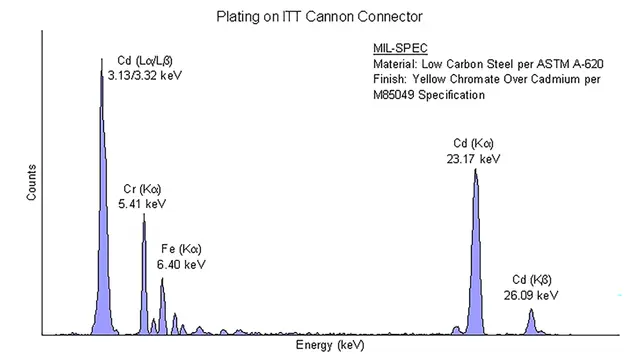
X-Ray Fluorescence (XRF) spectroscopy provides a fast, accurate, and non-destructive method for analyzing the elemental composition of metallic coatings and plating used on electronic connectors.
In applications where cadmium (Cd) is restricted or prohibited, verifying its presence or absence is essential for material compliance, quality assurance, and manufacturing process control.
The accompanying X-ray spectrum illustrates the elemental composition of the plating applied to a steel electronic connector. The characteristic fluorescence peaks clearly indicate the presence of both cadmium (Cd) and chromium (Cr) in the coating.
This example demonstrates the effectiveness of XRF technology for identifying plating materials, detecting restricted elements, verifying coating composition, and supporting regulatory compliance testing, without damaging the connector or compromising its functionality.
Gold (Au) Plated on Nickel (Ni)

XRF of a Saint Gaudens US $20 Gold Coin

XRF of a Platinum (Pt) Ring

XRF of a 14k Gold/White Gold (Au) Chain

XRF of Glass

XRF of Paper

Mössbauer Spectroscopy – High-Selectivity X-Ray Detection
The Amptek XR-100CR Si-PIN detector, featuring a 7 mm² active area and a 300 µm silicon thickness, is an excellent solution for Mössbauer spectroscopy applications requiring selective detection of low-energy gamma rays.
The detector's thin 300 µm silicon layer provides high detection efficiency at 14.4 keV, while significantly reducing sensitivity to higher-energy photons, particularly those at 122 keV.
The accompanying Cobalt-57 (⁵⁷Co) energy spectrum demonstrates this selective response, showing a detection efficiency ratio of approximately 1700:1 between 14.4 keV and 122 keV.
By placing a thin aluminum absorber between the radioactive source and the detector, the lower-energy 6.4 keV and 7.1 keV characteristic X-ray peaks can also be effectively suppressed.
This configuration allows the 14.4 keV peak to remain as the primary detectable energy peak, improving spectral selectivity and minimizing interference from unwanted radiation.
With its optimized silicon thickness, excellent energy discrimination, and compact thermoelectrically cooled design, the XR-100CR 7 mm² / 300 µm detector provides a reliable and efficient solution for Mössbauer spectroscopy, nuclear research, and precision gamma-ray measurements.

Multi-Element Fluorescence Sample

Low Z Element Fluorescence

241Am Spectrum

1.5 Inch Extender (standard)

Features
- Si-PIN Photodiode
- Available in 6, 13 and 25 mm2
- 2-Stage Thermoelectric Cooler
- Temperature Monitor
- Beryllium Window
- Multilayer Collimator
- Hermetic Package (TO-8)
- Wide Detection Range
- Easy to Operate
Applications
- X-Ray Fluorescence (XRF)
- RoHS/WEEE
- Portable Instruments
- OEM
- Nuclear Medicine
- Teaching and Research
- Art and Archaeology
- Process Control
- Mössbauer Spectrometers
- Space and Astronomy
- Environmental Monitoring
- Nuclear Plant Monitoring
- Toxic Dump Site Monitoring
- PIXE
Downloads
Need another document? Full specifications, declaration of conformity or user manual: ask us
More from AMPTEK AMETEK
View all-
AMPTEK AMETEK
AMPTEK X-Ray Detector
Amptek X-Ray Detector Selection Guide – Discover how to select the ideal high-performance, compact X-ray detector for your application. Compare Amptek’s FastSDD, Si-PIN, and CdTe detector technologies to find the best solution for your specific measurement requirements.
Get a quote -
AMPTEK AMETEK
AMPTEK FastSDD® X-Ray Detectors for XRF
The Amptek FastSDD® is a high-performance Silicon Drift Detector (SDD) engineered to deliver exceptional energy resolution and ultra-high count-rate capabilities exceeding 1,000,000 counts per second (CPS). Designed for demanding X-ray spectroscopy applications, the FastSDD® combines outstanding measurement accuracy, high-speed processing, and excellent spectral performance. For enhanced low-energy X-ray detection, the FastSDD® is also available with Amptek’s patented C-Series silicon nitride (Si₃N₄) windows, providing excellent sensitivity for soft X-ray analysis and advanced elemental characterization.
Get a quote

